5G Power Paddle
Blog entries

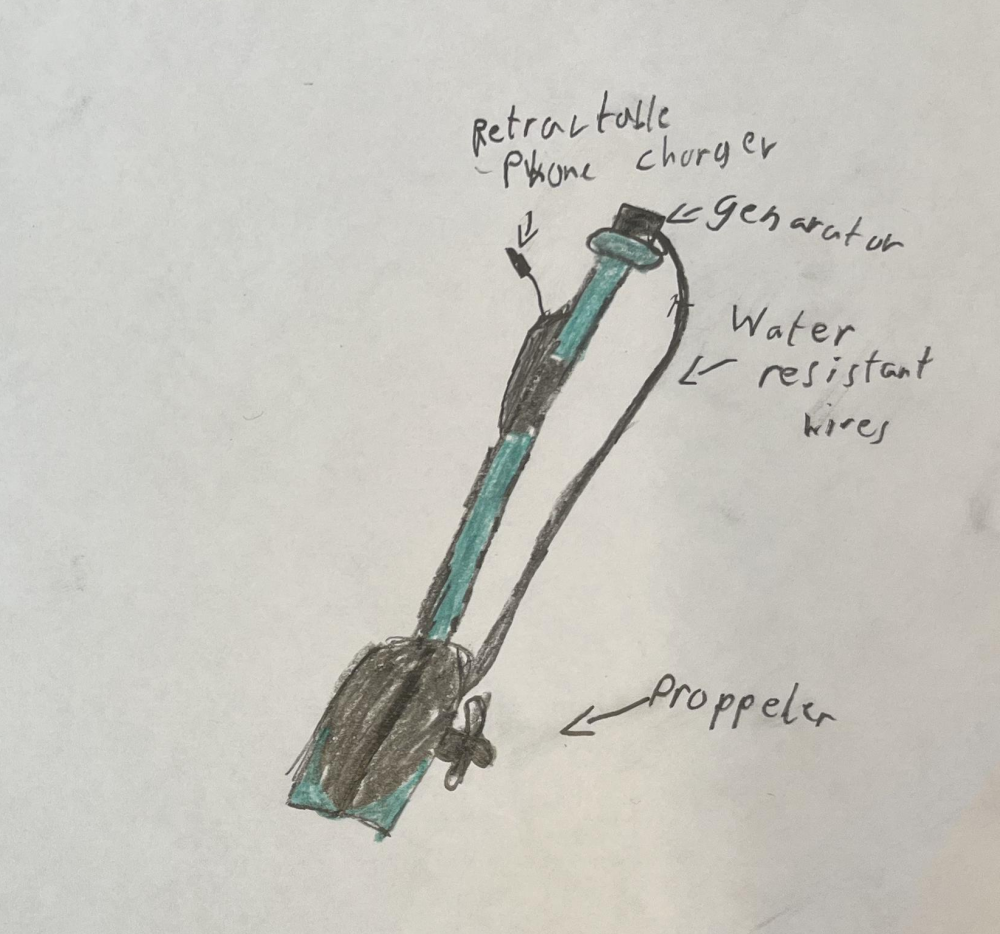
We've been working to help bring Dexter's 5G Power Paddle idea to life!
We had the opportunity to speak with Dexter about his invention and how he imagined it working, and we've since been exploring how to turn his idea into something physical.
The concept is simple: could you use the movement of a paddle through water to generate electricity, storing that energy to charge a mobile phone later?
It's a great idea, though it comes with some interesting engineering challenges. Small generators aren't necessarily very efficient at low speeds, and a paddle only moves through the water for part of each stroke.
To put some numbers to it, if we could generate 5 watts continuously for four hours, we'd collect 20 watt-hours of energy—roughly what's stored in a typical smartphone battery. Achieving that from a paddle is another matter, particularly once we factor in energy losses!
What's particularly interesting is how technology keeps improving. As electric motors and generators become more efficient, especially at smaller sizes, we can recover useful energy from movements that previously produced too little electricity to bother collecting. Combine that with improvements in batteries and electronics, and ideas like Dexter's become increasingly practical. It's a great example of why an invention that might be difficult to achieve today could become much more viable in the future.
For this first stage, we're developing a small-scale display model to explore the concept and show how the different parts of Dexter's invention could work together.
We've started designing the paddle in SOLIDWORKS, with a small propeller integrated into the blade. The idea is that water passing through the paddle would turn the propeller, providing the movement needed to generate electricity. We're also exploring ways to make the model interactive and demonstrate how that energy could be collected and stored.
There's still plenty to work through, but that's all part of the fun of taking an invention from a drawing to a physical design.
We're looking forward to getting the parts made and seeing it come together!